SMART Goals: From Goal to Executable Progress
How each SMART Goals principle maps to concrete mechanisms in BreakToGoal, turning goal definition into daily execution.

SMART goals are widely known.
They promise clarity, structure, and direction. Yet for many people, SMART still lives on paper — not in daily life.
The missing piece is not motivation or discipline. It is execution.
Most SMART goals are written with good intent. The problem is that SMART goals often stop at definition, while real progress depends on the next executable action.
That is why SMART goals need an execution layer.
BreakToGoal is built to bridge this gap: to turn SMART goals into things that actually move forward.
This page explains how SMART goals map directly to concrete mechanisms inside BreakToGoal — and how, together, they form an execution system rather than a planning framework.
S — Specific
Specificity Is Built Through Decomposition
SMART says goals should be specific. BreakToGoal asks a different question:
“Is this goal already small enough to act on?”
SMART goals become specific only when specificity turns into something a person can do.
In BreakToGoal, specificity is not decided once. It is constructed gradually.
Inside BreakToGoal, SMART goals are made specific through repeated decomposition, not better wording alone.
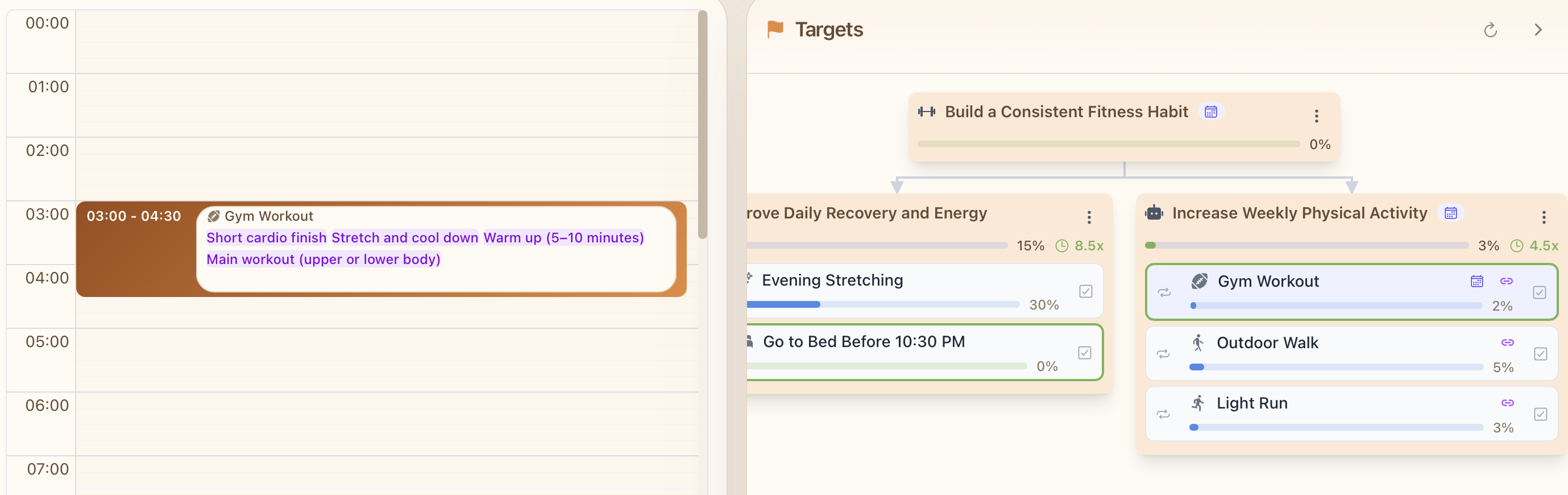
Large goals can be split repeatedly — until they become small goals that feel easy to execute.
Once a goal is small enough:
- Concrete tasks can be attached
- Tasks represent real, repeatable actions
- Over time, tasks naturally form personal SOPs
That is where SMART goals move from wording → behavior.
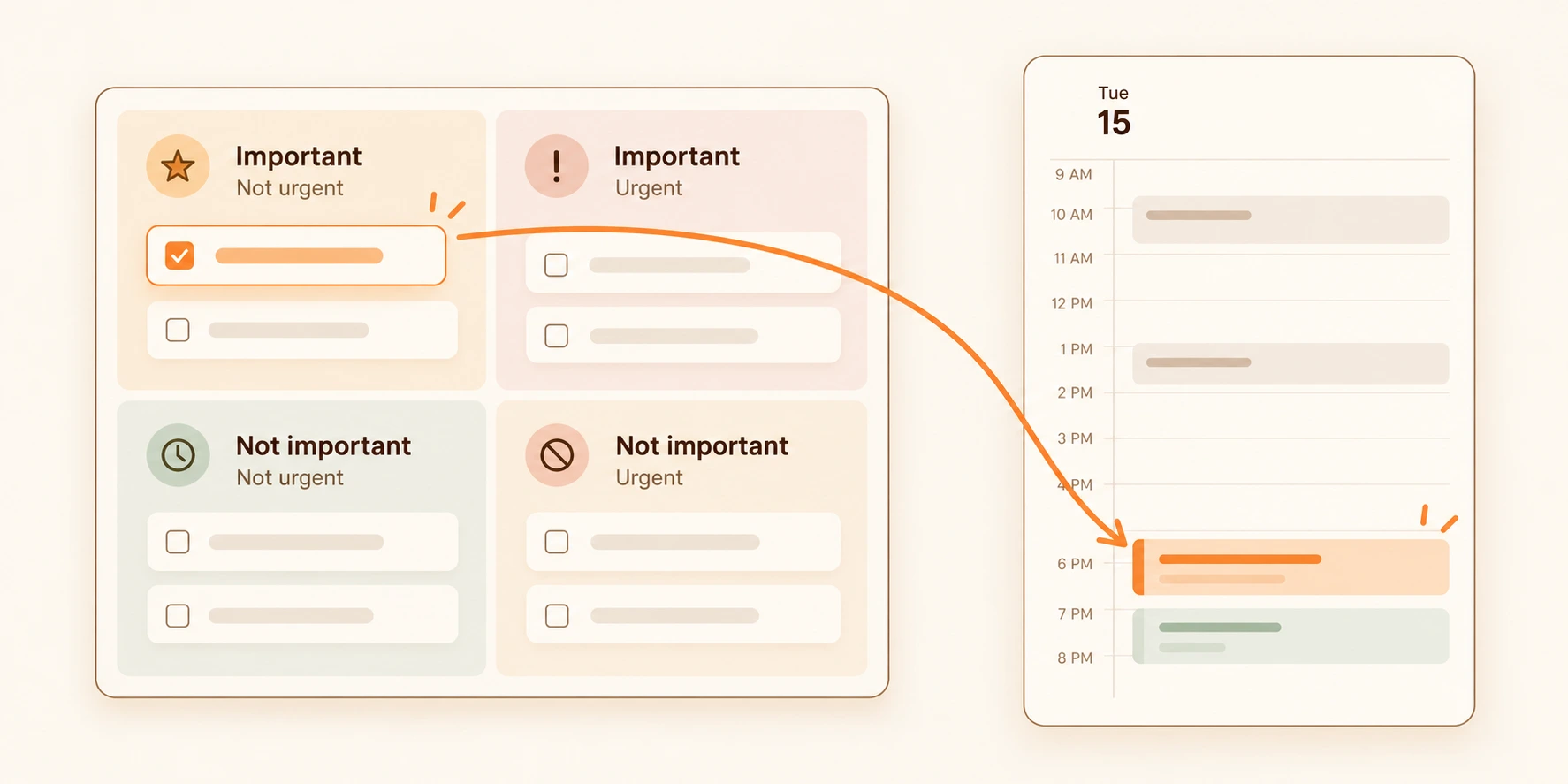
When tasks are dragged into the calendar, users can further add activities to clarify how each execution session should unfold.
Specific goals are not better descriptions. They are clear execution structures.
M — Measurable
Measurement That Answers “What Should I Do Today?”
SMART emphasizes measurability. BreakToGoal focuses on useful measurement.
With SMART goals, measurement is useful only when it changes today’s decision.
In BreakToGoal, progress is measured through three practical signals:
- Completed task repetitions — what has actually been done
- Required task repetitions — how many completions the goal still needs
- Remaining time — how much space is left to act
Completed tasks advance goal progress directly. Repeated completion shows whether the current execution rhythm is strong enough.
This makes effort visible without judgment.
BreakToGoal keeps SMART goals measurable by connecting progress to completed work, not abstract reporting.
When a target date exists, BreakToGoal goes further:
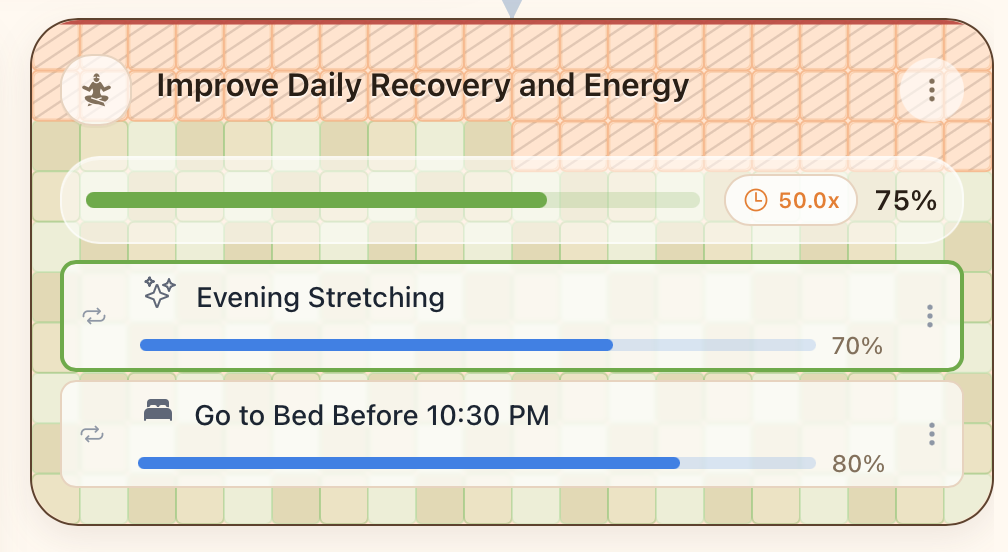
- The target progress grid turns required completions into visible cells
- Completed cells show what has already moved forward
- Planned cells preview how much still needs to be done today
- The deadline marker maps time progress onto the same grid
Measurement stops being retrospective. It becomes a daily guide: users can compare execution progress, remaining scope, and time rhythm at a glance.
A — Achievable
If It Can Be Placed in Time, It Is Achievable
SMART often treats “achievable” as a judgment call.
For SMART goals, achievable should not mean guessing whether a plan feels realistic.
BreakToGoal turns it into a system property.
In BreakToGoal:
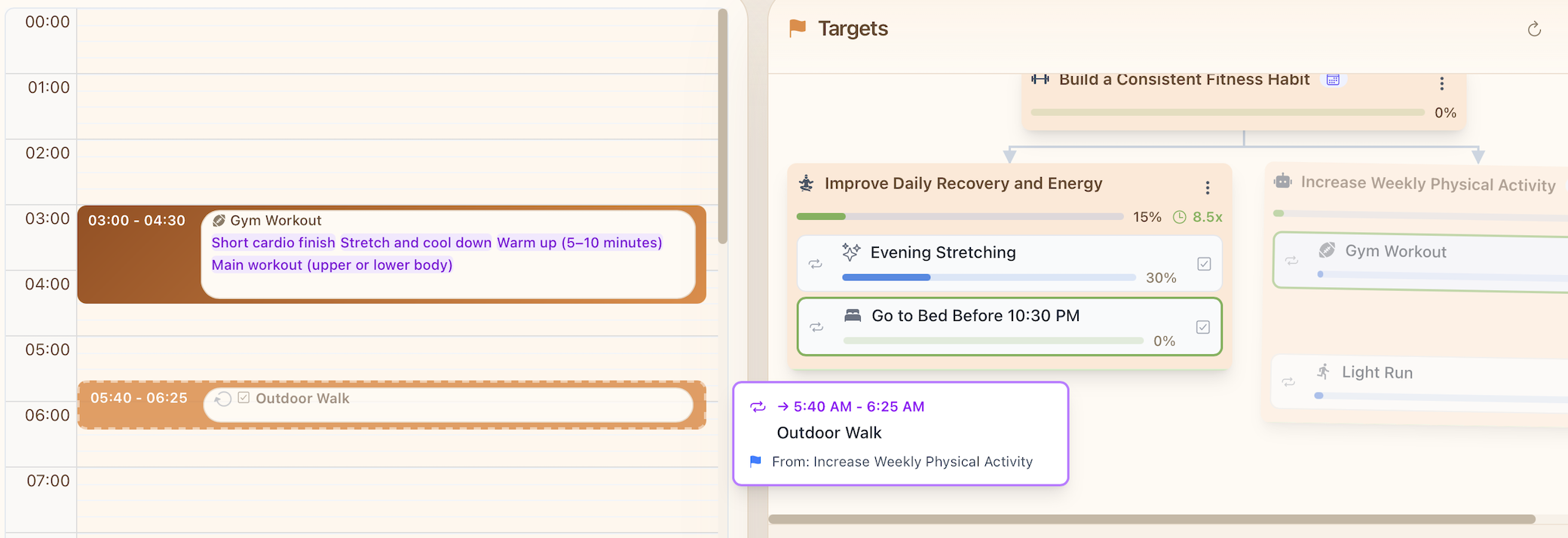
- Time recipes
- Target-bound tasks
can be dragged directly into the calendar.
BreakToGoal makes SMART goals achievable by letting users place actions into real time.
No rewriting. No translation. No planning gap.
If something can be placed into real time, it is considered executable.
Once executed, calendar events automatically advance the related goal.
Executing time is executing the goal.
Achievability no longer depends on confidence or motivation. It depends on whether execution is frictionless.
R — Relevant
When Every Action Knows What It Serves
Relevance is often treated as something users must remember.
BreakToGoal treats relevance as something the system guarantees.
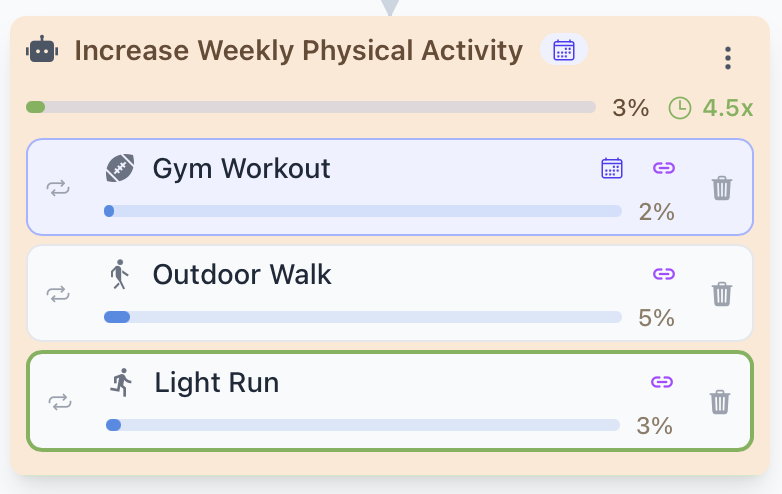
SMART goals stay relevant when every action can point back to the goal it serves.
Every task belongs to a goal.
This creates a closed loop:
- Completing a task advances a goal
- Goals give tasks meaning
- Actions never drift silently
There is no gap between “doing” and “progressing”.
If a task does not support any goal, it becomes visible immediately. If a goal has no executable tasks, it feels empty.
Relevance is maintained structurally, not emotionally.
T — Time-bound
Time as Rhythm, Not Pressure
Time-bound goals are often misunderstood as deadlines.
For SMART goals, time-bound works best when time creates rhythm instead of pressure.
BreakToGoal reframes time as a pacing reference.
When a target date is set:
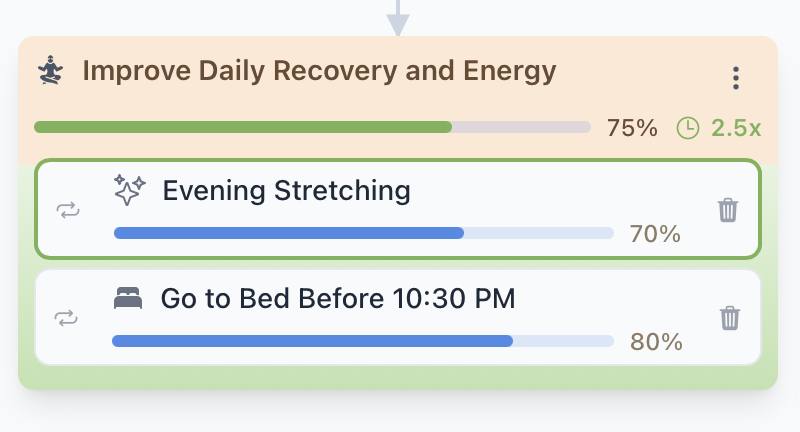
- Time progress becomes visible inside the goal card
- Execution progress is compared against time progress
- Users can instantly tell whether they are on a healthy rhythm
When execution is ahead of time:
- The background turns green
- Daily expectation indicators turn green
This is not urgency. It is reassurance.
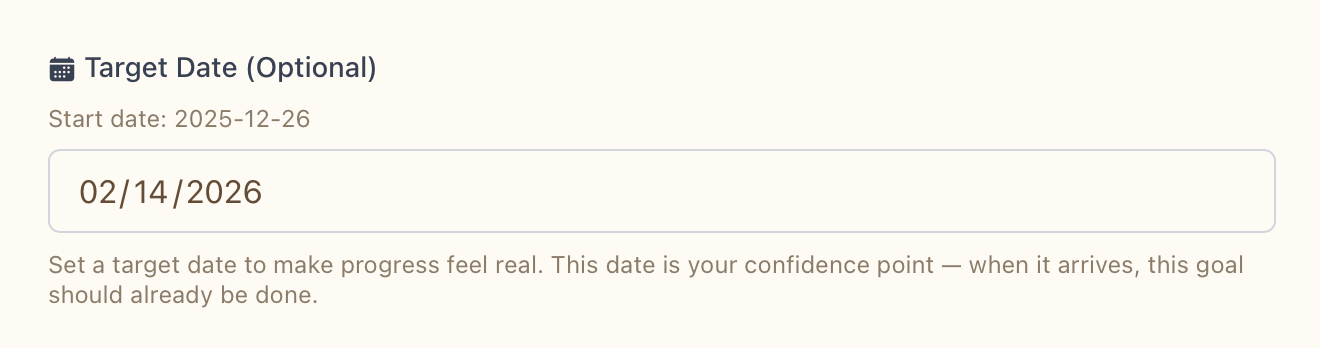
If a goal exists for several days without a target date, BreakToGoal gently prompts the user — because only time-bound goals can be meaningfully evaluated for scope, repetition, and execution rhythm.
A target date sends a quiet signal:
“If I keep completing these tasks, this goal will almost certainly be done by then.”
SMART as an execution system
Individually, SMART principles describe good goals.
Together, inside BreakToGoal, SMART goals form something else:
- S defines executable structure
- M creates daily clarity
- A removes the gap between plan and action
- R prevents meaning drift
- T establishes a trustworthy rhythm
BreakToGoal doesn’t help users think harder about goals. It helps goals move forward through action.
One guiding sentence
SMART goals don’t fail because they’re poorly defined. They fail because execution is not designed.
BreakToGoal designs execution.
Share this post
About the Author
BreakToGoal Team
Passionate about productivity, time management, and helping people achieve their goals through innovative approaches.